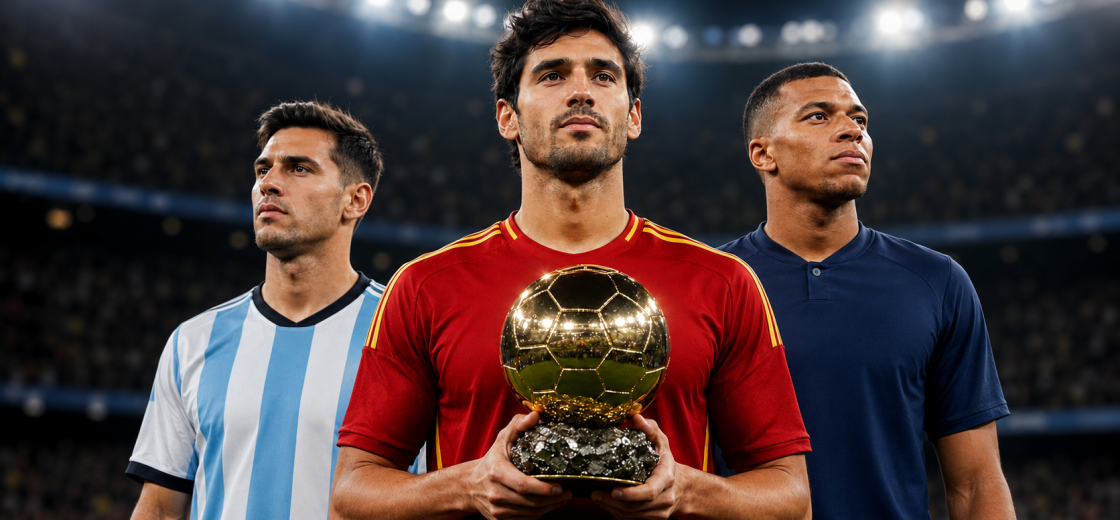
Rodri won the 2026 FIFA World Cup Golden Ball ahead of Lionel Messi and Kylian Mbappé. It was a decision that divided football fans. Messi recorded eight goals and four assists, while Mbappé scored ten goals and won the Golden Boot. Rodri registered neither a goal nor an assist. So, how did a defensive midfielder beat the tournament’s two most productive attackers?
The answer is simple, but often missed in football debates: the Golden Ball is not an award for the highest scorer. It recognises the player judged to have produced the best overall tournament. Rodri’s influence was found in possession, defensive control, pressing, positioning and leadership rather than goals.
2026 World Cup Golden Ball results
| Position | Player | Country | Award |
|---|---|---|---|
| 1 | Rodri | Spain | Golden Ball |
| 2 | Lionel Messi | Argentina | Silver Ball |
| 3 | Kylian Mbappé | France | Bronze Ball |
FIFA officially named Rodri the tournament’s best player after he helped Spain win their second World Cup title. Messi finished second, while Mbappé took third place and also collected the Golden Boot. The full list was published in FIFA’s official 2026 World Cup awards announcement.
Rodri vs Messi vs Mbappé at World Cup 2026
| Player | Key contribution | Final award |
|---|---|---|
| Rodri | Controlled Spain’s midfield, completed 93.2% of his passes and made a tournament-high 26 tackles | Golden Ball |
| Lionel Messi | Eight goals, four assists and led Argentina to the final | Silver Ball |
| Kylian Mbappé | Ten goals and four assists | Bronze Ball and Golden Boot |
Why Rodri won the Golden Ball
1. He controlled the World Cup-winning team
Spain’s football was built around control. Rodri determined when the team accelerated, slowed the game or recycled possession. He was also the link between Spain’s defence and its attacking midfielders.
This role is less dramatic than scoring goals, but it affects almost every possession. Spain could push its full-backs and attacking players forward because Rodri protected the space behind them.
2. His passing combined volume with accuracy
Rodri completed 93.2% of his passes during the tournament. He averaged 94 completed passes per 90 minutes, the highest recorded by a player who played at least 400 minutes in a single World Cup.
These were not merely harmless sideways passes. Rodri completed 204 passes in the attacking third, more than any other player in the competition, while maintaining 91.9% accuracy in that area.
3. His defensive statistics were equally strong
Rodri made 26 tackles, the most by any player at the tournament. He also won 63.3% of his 60 ground duels, a remarkably high success rate for a midfielder operating in crowded central areas.
His defensive contribution allowed Spain to dominate the ball without becoming vulnerable to counterattacks. Opponents rarely managed to play directly through Spain’s midfield.
4. He produced his best football in the final
Rodri completed 101 of his 106 passes against Argentina, giving him a 95.3% passing accuracy in the biggest match of the tournament. He also won 80% of his ground duels.
One of his most important actions came late in normal time when he dispossessed Messi as the Argentine captain approached Spain’s penalty area. It was not a spectacular goal or assist, but it potentially stopped a decisive Argentina attack.
A detailed statistical examination by The Guardian showed how Rodri combined exceptional passing accuracy with the tournament’s strongest tackling numbers.
The case for Lionel Messi
Messi had the strongest attacking case. He contributed eight goals and four assists and led Argentina to another World Cup final at the age of 39. His ability to create and score decisive goals was unmatched by Rodri.
If the award were based mainly on direct goal contributions or individual attacking brilliance, Messi would have been a perfectly reasonable winner. His hat-trick against Algeria was also rated by Sky Sports as the tournament’s best individual performance.
The case for Kylian Mbappé
Mbappé scored ten goals and provided four assists, giving him the highest number of direct goal contributions at the tournament. He finished two goals ahead of Messi and deservedly won the Golden Boot.
However, the Golden Boot and Golden Ball measure different things. Mbappé was the leading scorer, while FIFA’s Golden Ball recognised Rodri’s wider influence on the team that won the competition.
Was Rodri clearly better than Messi and Mbappé?
No. The decision was debatable.
Sky Sports analysed more than 40 performance metrics and placed Messi, Mbappé and Jude Bellingham as its top three players. Rodri was ranked only 18th in that particular model. Messi and Mbappé each finished inside the top ten across 18 measured categories, compared with Rodri’s 13.
That data supports the argument that Messi or Mbappé had the better individual tournament. However, statistical models depend on what they choose to value. Goals, assists and chances created naturally favour attackers. Positional discipline, match control and preventing attacks are much harder to measure.
The contrasting view is explained in this Sky Sports analysis of the Golden Ball debate.
Final verdict
Rodri won because he controlled the most successful team in the competition. He dictated possession, protected the defence, led the tournament in tackles and maintained extraordinary passing accuracy, including in the final.
Mbappé scored the most. Messi created the most magic. Rodri controlled the team that won the World Cup.
The award was not an obvious or undisputed choice. Messi and Mbappé had superior attacking numbers. But judging a midfielder only by goals and assists is like judging a goalkeeper by the number of goals he scores. Rodri’s influence was quieter, broader and central to Spain’s success.
Frequently asked questions
Who won the 2026 FIFA World Cup Golden Ball?
Spain midfielder Rodri won the 2026 FIFA World Cup Golden Ball. Lionel Messi received the Silver Ball and Kylian Mbappé received the Bronze Ball.
Why did Rodri win despite scoring no goals?
The Golden Ball considers a player’s overall tournament performance, not just goals. Rodri controlled Spain’s midfield, completed 93.2% of his passes and made more tackles than any other player.
Who won the 2026 World Cup Golden Boot?
Kylian Mbappé won the Golden Boot after scoring ten goals for France. Messi finished second in the scoring race with eight goals.
Did Messi deserve the Golden Ball instead?
Messi had a strong claim because of his eight goals, four assists and Argentina’s run to the final. Rodri’s victory reflected greater emphasis on tactical control, defensive contribution and Spain winning the tournament.
Statistics and award information were checked against FIFA, Opta-based reporting, The Guardian and Sky Sports on 22 July 2026.
