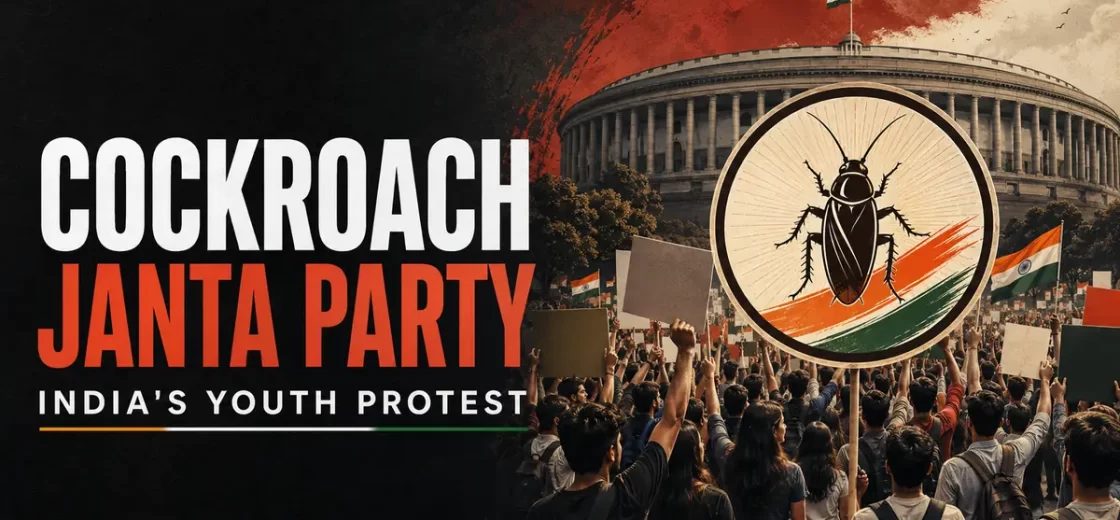
India’s political landscape has acquired an unlikely new symbol: the cockroach.
The Cockroach Janta Party, commonly known as CJP, began as an online satirical response to a controversial remark attributed to Chief Justice of India Surya Kant. Within weeks, it evolved into a wider youth-led campaign focused on unemployment, examination irregularities, corruption and government accountability.
What initially looked like another social media joke has now brought thousands of protesters onto the streets of Delhi and captured national and international attention.
But can viral anger become a lasting political force?
How did the Cockroach Janta Party begin?
The controversy began during a Supreme Court hearing in May 2026. Early reports said the Chief Justice had compared some unemployed young people moving towards journalism and activism to “cockroaches” and “parasites”.
The Chief Justice later clarified that his comments were directed at people with allegedly fake or bogus qualifications, and not at India’s youth as a whole. This clarification is important because the original remark was widely circulated online without its full context. BBC’s report on the controversy documented both the criticism and the clarification.
However, by then, the imagery had already taken hold.
Abhijeet Dipke, a communications professional and the founder of CJP, reclaimed the cockroach as a symbol of young people who feel ignored, insulted and pushed aside by the system.
The idea was simple but politically effective: cockroaches are disliked and frequently attacked, yet they are notoriously difficult to eliminate.
Satirical posts, memes and videos quickly spread across social media. The “party” became an umbrella identity for frustrated students, unemployed graduates and young professionals.
Is the Cockroach Janta Party a real political party?
Despite its name, the Cockroach Janta Party currently functions mainly as a satirical political movement and protest platform, rather than a conventional electoral party with an established organisation, candidates and election machinery.
Its strength comes from humour, online participation and the ability to convert personal frustration into a shared identity.
Its official messaging mixes serious demands with political satire. This has allowed the movement to reach young people who may not identify with traditional political parties.
But social media popularity and electoral strength are two very different things. Turning millions of followers into disciplined local organisations, credible leadership and votes would be a far harder task.
Why are young Indians supporting CJP?
The movement is built around several related grievances.
1. High unemployment among educated youth
India has approximately 367 million young people and produces roughly five million graduates every year. The economy continues to expand, but the creation of stable, skilled and adequately paid jobs has not kept pace with the expectations of educated job seekers.
India’s overall unemployment rate was reported at around 5.5% in June 2026. However, this national figure hides much higher unemployment among younger and more educated groups.
The State of Working India 2026 report found that unemployment among graduates aged 15-25 was nearly 40%, while the figure was around 20% among graduates aged 25-29.
These percentages should not be directly compared with the national unemployment rate because they cover different age groups and labour-market categories. Nevertheless, Azim Premji University’s report demonstrates the scale of India’s graduate employment problem.
2. Economic growth without enough suitable jobs
India’s economic growth has created employment, but not always the kind of employment that qualified young people expect.
Many graduates struggle to find professional positions that offer:
- Reasonable salaries
- Job security
- Social protection
- Career progression
- Work matching their education and skills
This creates a situation in which the country can report economic growth and relatively modest overall unemployment while millions of educated young people still feel excluded from meaningful opportunity.
3. Dependence on gig-economy work
Food delivery, ride-hailing and other platform-based jobs provide an important source of income. There is nothing undignified about such work.
The problem is that many gig jobs offer limited security, irregular earnings and few opportunities for long-term career development. A graduate working as a delivery rider is technically employed, but that does not necessarily mean the education-to-employment system is working properly.
Employment numbers alone tell only part of the story. Job quality matters as much as job quantity.
4. Examination leaks and recruitment irregularities
For millions of Indian students, education and competitive examinations are expected to provide a fair route towards medical education, government service and economic security.
Repeated allegations of leaked question papers and compromised recruitment examinations have weakened that belief.
Government jobs are especially attractive because they generally provide greater stability, predictable salaries and social protection. When candidates believe entrance or recruitment examinations have been manipulated, the damage goes beyond one cancelled test. It undermines trust in the entire system.
CJP has demanded stronger examination safeguards, accountability for paper leaks and reforms that ensure candidates are not punished for administrative or criminal failures beyond their control.
The Cockroach Janta Party march towards Parliament
On July 20, 2026, thousands of CJP supporters gathered in central New Delhi as Parliament’s monsoon session began.
Protesters attempted to march from Jantar Mantar towards Parliament while demanding education reforms and the resignation of Education Minister Dharmendra Pradhan over alleged examination failures and repeated paper leaks.
Police said the march had not been authorised and that restrictions were necessary to maintain security around Parliament. Police subsequently used tear gas and batons after demonstrators attempted to cross barricades.
The protest included students, working professionals and families. Some participants continued moving towards Parliament in smaller groups after the main gathering was dispersed.
Associated Press and Reuters documented the demonstration and police response.
The mobilisation marked a major transition for CJP. It was no longer merely an online meme. It had demonstrated an ability to bring substantial numbers of people onto the streets.
Why the CJP movement matters politically
The CJP movement has emerged during Prime Minister Narendra Modi’s third term, when the BJP remains the dominant national political force.
For opposition parties, youth unemployment and examination scandals offer an opportunity to challenge the government. However, CJP’s appeal partly comes from its distance from conventional party politics.
Becoming too closely associated with established opposition parties could weaken its image as an independent youth movement.
Its long-term political impact will depend on whether it can:
- Maintain a peaceful and issue-based campaign
- Build organisations outside social media
- Develop transparent and accountable leadership
- Prevent political parties from hijacking the movement
- Convert general anger into achievable policy demands
- Retain public attention after the viral moment passes
Viral popularity is not political infrastructure. Instagram followers do not automatically become volunteers, local committees or voters.
Part of a wider South Asian trend
The rise of the Cockroach Janta Party also fits into a broader pattern of youth-led mobilisation across South Asia.
Young people played major roles in protests in Sri Lanka, Bangladesh and Nepal, driven by combinations of unemployment, corruption, inequality, censorship and dissatisfaction with established political elites.
Some of these movements forced leadership changes, but they also showed that removing a government is easier than building stable and democratic alternatives. An Associated Press analysis examined the opportunities and risks created by these regional protests.
India’s political institutions, size and electoral structure are very different. It would therefore be simplistic to assume that CJP will follow the same path.
Still, the message from the region is clear: digitally connected young people are increasingly unwilling to accept unemployment, corruption and institutional failure quietly.
Can CJP become a lasting political force?
The Cockroach Janta Party has already succeeded in one respect. It transformed language intended or perceived as dismissive into a symbol of resilience and collective protest.
Its future is less certain.
The movement could grow into an organised political platform, remain an influential pressure group or disappear when social media attention shifts elsewhere. Much will depend on its leadership, funding transparency, organisational discipline and ability to present practical solutions.
But dismissing it as merely an internet joke would be a mistake.
What happens when millions of educated young people believe that economic growth, competitive examinations and democratic institutions are no longer delivering a fair future?
That question will remain relevant even if the Cockroach Janta Party itself does not.
Frequently Asked Questions
Who founded the Cockroach Janta Party?
The movement was founded by communications professional Abhijeet Dipke in May 2026.
Why is it called the Cockroach Janta Party?
The name was adopted after controversial remarks attributed to the Chief Justice of India. Supporters reclaimed the cockroach as a symbol of survival and resistance.
What does CJP demand?
Its principal demands include education reforms, fair examinations, action against paper leaks, better employment opportunities and greater government accountability.
Is CJP an officially established electoral party?
CJP currently operates mainly as a satirical youth movement and protest platform. It has not yet demonstrated the structure or electoral machinery of a conventional national political party.
Why is graduate unemployment high in India?
Major factors include insufficient professional job creation, mismatch between education and industry requirements, intense competition, uneven economic development and dependence on insecure or low-paying work.
Editorial note: Unemployment estimates can vary according to the age group, survey method, reference period and definition used. Figures covering graduate youth should not be directly compared with India’s overall unemployment rate.
