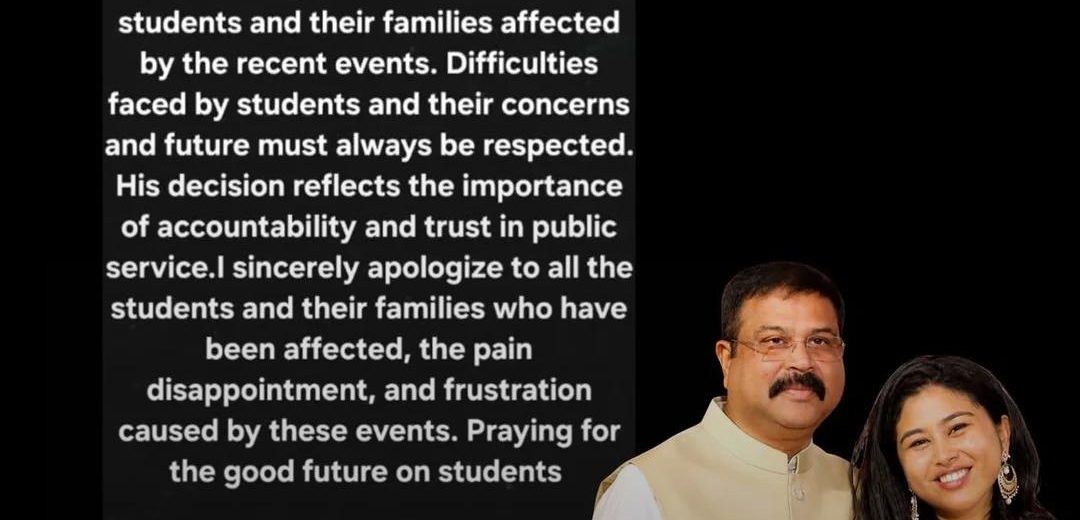
Dharmendra Pradhan’s resignation and his daughter’s reported response have triggered a wider debate about political accountability, privilege, public resources and the ethics of targeting politicians’ families.
Union Education Minister Dharmendra Pradhan’s resignation on 25 July 2026 was presented as an act of responsibility following weeks of student protests over alleged examination paper leaks and failures in India’s competitive examination system.
But a reported social media response from his daughter, Naimisha Pradhan, has opened another argument: Did the minister genuinely accept responsibility, or did sustained public pressure finally force him out? And how far should public anger extend towards the family of an elected politician?
A Reddit discussion in r/indiameme captures this conflict in unusually blunt terms.
What reportedly happened
Dharmendra Pradhan resigned after nationwide protests led by students and the youth-driven Cockroach Janta Party, or CJP. The demonstrations focused on examination leaks, irregularities, lack of institutional accountability and the treatment of protesters.
Following the resignation, Naimisha Pradhan reportedly posted a statement saying her father had taken responsibility by stepping down. She also referred to messages she had received from students and affected families and expressed hope for a better future for students.
The available material is a screenshot circulated on social media and Reddit. Its exact origin and complete wording could not be independently authenticated. It must therefore be treated as a reported statement, not a verified official communication.
Her Instagram account had reportedly been deactivated earlier after users flooded her posts with comments about her father, her overseas education and the examination controversy. Some users reportedly contacted or tagged Tufts University, where she studied.
Why Pradhan resigned
The resignation came after sustained youth protests, negotiations with the government and growing political pressure over alleged examination paper leaks and wider failures in the examination system.
In his resignation statement, Pradhan said he had accepted responsibility and did not want “anti-national elements” to benefit from the situation. That wording attracted criticism because it appeared to shift part of the attention from administrative failure to alleged external exploitation.
Opposition parties described the resignation as a victory for students but argued that it was only the beginning. They demanded deeper examination reforms, accountability for the alleged police action against protesters and an apology from the government.
“He resigned” versus “we made him resign”
The dominant reaction on Reddit challenged the claim that Pradhan voluntarily accepted responsibility.
Several commenters argued that accepting responsibility means acting when a failure becomes known, not waiting until protests, hunger strikes, police action and multiple rounds of negotiations make remaining in office politically difficult.
“He did not offer the resignation. We took it from him.” A widely shared sentiment in the Reddit discussion
Another commenter argued that the protests might never have reached such intensity if ministers had accepted responsibility early.
This is more than wordplay. A voluntary resignation is an ethical decision. A resignation following prolonged public pressure may still be politically important, but it cannot automatically be rewritten as spontaneous moral accountability.
A more accountable statement than her father’s?
A few participants observed that Naimisha’s reported statement at least spoke about responsibility and acknowledged students’ concerns. In their view, it was more measured than her father’s resignation letter.
One commenter said that the daughter appeared to show “more courage than her father”. Another appreciated that she expressed sympathy rather than attacking the protesters or portraying herself entirely as a victim.
Others were deeply sceptical. They described the statement as professionally drafted, public-relations-driven or intended to repair the family’s image. These are opinions and suspicions, not established facts.
The overseas education question
Naimisha reportedly studied at Tufts University’s Fletcher School in Massachusetts and later worked with the US-India Strategic Partnership Forum. Her foreign education became a central focus of the online backlash.
Critics asked why the daughter of India’s education minister chose an American institution while millions of Indian students were struggling with limited seats, paper leaks and uncertainty surrounding national examinations.
The anger may be understandable, but the argument requires precision. Studying abroad is not evidence of wrongdoing. Indian citizens, including the children of politicians, have the right to study or work wherever they qualify and can afford to do so.
The legitimate public-interest questions are:
- Was any public money improperly used?
- Did she receive benefits unavailable to ordinary citizens?
- Was there any conflict of interest?
- Did the minister use his position to secure personal advantages?
- Were any benefits properly declared and authorised?
Without evidence on these points, foreign education alone proves nothing. It may reveal political hypocrisy when leaders glorify domestic institutions while their families choose foreign ones. But hypocrisy and corruption are not automatically the same thing.
The ₹68,424 Petronet phone-bill allegation
A large number of Reddit comments demanded an explanation or repayment of an alleged ₹68,424 international mobile bill.
The allegation concerns documents circulated online relating to an international SIM reportedly issued in Naimisha Pradhan’s name during a foreign trip in 2017, when Dharmendra Pradhan was petroleum minister. Reports claim that Petronet LNG processed the bill, which allegedly included more than ₹53,000 in international usage charges.
However, the available online material does not establish the complete administrative context. It remains unclear:
- Who formally requested the connection?
- Whether the trip had an official component
- Under which policy the expense was processed
- Whether the amount was subsequently recovered
- Whether an audit or competent authority found wrongdoing
- Whether Petronet LNG or the ministry issued a detailed clarification
The claim must be reported as an allegation requiring an official explanation, not as a conclusively proven corruption case.
Petronet LNG, the Ministry of Petroleum and Natural Gas and Dharmendra Pradhan should disclose the relevant approvals, invoices, reimbursement records and audit findings. Transparent records can settle the matter more effectively than viral videos or partisan slogans.
Should a politician’s daughter be targeted?
This was the strongest ethical disagreement in the Reddit discussion.
Some users argued that the public targeted Naimisha because the minister remained inaccessible and unresponsive. They said contacting her or her university became an indirect method of making public anger visible.
Others warned, correctly, that children should not be punished for the conduct of their parents.
Naimisha Pradhan does not hold elected office. Her father’s administrative decisions do not automatically become her legal or moral responsibility. Flooding her private messages, demanding that an employer dismiss her or pressuring a university to punish her without evidence of personal wrongdoing crosses the line from political criticism into collective punishment.
One Reddit commenter highlighted the wider danger: if targeting politicians’ relatives becomes acceptable, political parties can employ the same method against protesters, journalists and activists.
That is not democratic accountability. It is organised harassment wearing an activist badge.
What the Reddit discussion broadly said
- The resignation was forced: Most commenters rejected the suggestion that Pradhan voluntarily accepted responsibility.
- The daughter’s statement was image management: Several users suspected that it was professionally drafted or intended to protect the family’s public image.
- Privilege deserves scrutiny: Users questioned her foreign education, family privilege and alleged benefits connected to her father’s position.
- The phone-bill allegation needs answers: Repeated demands were made for the alleged ₹68,424 expense to be officially explained.
- Personal harassment is wrong: A smaller but important group argued that she should not be abused or punished merely for being the minister’s daughter.
Some comments also contained misogynistic abuse, unverified corruption claims, conspiracy theories and calls for punitive action against her. Such comments add heat, not evidence, and should not be treated as serious political analysis.
A resignation does not repair the examination system
One participant raised the most practical question: What actually changes after the minister resigns?
Changing the minister may establish political accountability, but it does not automatically:
- secure examination papers;
- reform the National Testing Agency;
- improve supervision of private vendors;
- identify and prosecute examination leak networks;
- compensate affected candidates;
- prevent coaching and examination rackets;
- protect whistleblowers;
- publish investigation findings; or
- restore students’ lost time and trust.
The government must publish a clear reform programme with deadlines, named responsible officials, independent audits and periodic public reports. Otherwise, the resignation becomes merely a pressure-release valve while the same defective machinery continues operating.
The sensible conclusion
Dharmendra Pradhan’s resignation is politically significant because sustained democratic protest compelled the government to respond. But resignation should be the beginning of accountability, not its substitute.
Naimisha Pradhan’s reported statement can be criticised, examined and questioned. Allegations involving public resources must also be investigated transparently.
But she should not be abused or punished for her father’s actions unless credible evidence establishes her own involvement in wrongdoing.
A democracy must be capable of doing two things simultaneously: holding powerful politicians accountable and refusing to turn their relatives into collateral targets.
Anything less is either political impunity or mob justice. Neither will fix Indian education.
Editorial note: Social-media screenshots and allegations cited in this article should not be treated as independently proven facts unless confirmed through primary documents or official records.
