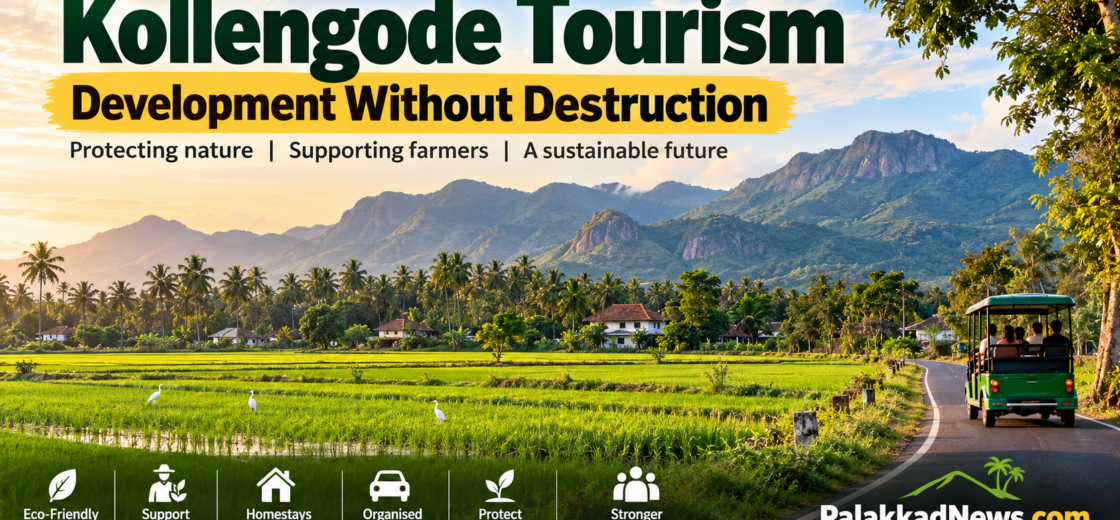
Kollengode Tourism Development: A Sustainable Plan to Protect Nature, Support Farmers and Build a Better Future
Kollengode, Palakkad, Kerala: Kollengode is increasingly attracting visitors for its scenic paddy fields, traditional villages, coconut groves and spectacular views of the Western Ghats. However, the growing popularity of this picturesque region also raises an important question: How can Kollengode develop tourism without destroying the very landscape that makes it special?
Unregulated construction, increasing vehicle traffic, inadequate parking, waste disposal problems and pressure on agricultural land could eventually threaten the area’s natural beauty and rural character.
The solution is not simply to attract more tourists. Kollengode needs a long-term sustainable tourism development plan that protects agricultural land, improves infrastructure, generates local employment and ensures that farmers benefit directly from tourism.
Why Kollengode Needs a Comprehensive Tourism Development Plan
A report published in the Vadakkenchery edition of Mathrubhumi on 18 October 2026 highlighted several infrastructure and traffic-related issues affecting Kollengode.
The report brought attention to important requirements, including:
- Road renovation and improvements to local transport infrastructure.
- Development of the Kollengode bus stand road.
- Proper pedestrian footpaths and zebra crossings.
- Improvement of electricity distribution infrastructure.
- Better cleanliness and waste management.
- Traffic regulation and safer roadside conditions.
- Removal of dangerous roadside encroachments through lawful procedures.
The initiative by local journalist Bhaskaran Mash deserves appreciation for bringing these important issues into public discussion.
However, infrastructure development alone is insufficient. Kollengode also needs a clear tourism management strategy that considers environmental sustainability, agriculture, local livelihoods and the long-term interests of residents.
Without timely intervention, the scenic agricultural landscape that attracts visitors today could gradually disappear under commercial development.
1. Establish a Kollengode Regional Tourism Management Authority
The first priority should be establishing a coordinated tourism management mechanism involving Kollengode and neighbouring gram panchayats.
Tourism does not operate within administrative boundaries. Visitors move across several villages, agricultural landscapes, roads and attractions. Therefore, isolated development activities by individual local bodies may not produce sustainable results.
Proposed stakeholders
- Kollengode and neighbouring gram panchayats.
- District Tourism Promotion Council (DTPC), Palakkad.
- Kerala Tourism Department.
- Kerala Responsible Tourism Mission.
- Agriculture Department and local farmers.
- Police and Motor Vehicles Department.
- Kudumbashree and local entrepreneurs.
- Homestay operators and tourism service providers.
- Environmental experts and local residents.
The proposed body should coordinate tourism planning, traffic management, environmental protection, public facilities, infrastructure maintenance and community participation.
A new statutory authority would require appropriate legal and government approvals. As an immediate measure, the existing institutions could establish a joint tourism coordination committee.
2. Develop Two Tourist Parking and Transfer Stations
One of the most practical proposals is to establish two designated tourist parking and transfer stations at suitable entry points to the main sightseeing areas.
These facilities could function as tourist arrival centres where visitors park their vehicles before proceeding on organised local tours.
Essential facilities
- Organised parking for cars and tourist vehicles.
- Clean public toilets and drinking water.
- Tourist information and booking counters.
- Electric vehicle charging facilities.
- Waiting areas with shade and seating.
- Waste segregation and collection facilities.
- Digital payment and ticketing systems.
From these stations, visitors could use approved electric tourist shuttles to explore designated routes.
This would help reduce unnecessary vehicle movement, roadside parking and traffic congestion in narrow village roads.
Important: Parking restrictions must be based on traffic studies and implemented by competent authorities. Residents, agricultural vehicles, emergency services and people with disabilities must retain appropriate access.
3. Introduce Eco-Friendly Electric Guided Village Tours
Kollengode’s main attraction is its rural landscape and agricultural lifestyle. A well-planned guided tourism network could help visitors experience the region without causing excessive environmental disturbance.
Small, road-legal electric tourist shuttles could operate from designated arrival centres along approved sightseeing routes.
Although electric go-karts may appear attractive, vehicles used on public roads must comply with applicable transport regulations, registration requirements and safety standards.
Suggested tourism experiences
Scenic Village Tour
A 60-90 minute guided experience covering selected viewpoints, paddy fields, traditional houses and rural landscapes, with stops only at approved locations.
Agricultural Experience Tour
A guided introduction to paddy cultivation, irrigation practices, agricultural equipment and seasonal farming activities, organised with the consent of participating farmers.
Rural Lifestyle Tour
A half-day or full-day experience involving local cuisine, traditional occupations, village heritage and community interactions.
Photography and Nature Tour
Small-group tours designed for landscape photography, nature observation and responsible birdwatching.
Tour routes must avoid disturbing agricultural work, blocking local roads or intruding into private properties.
4. Make Farmers and Homestay Owners Direct Beneficiaries
Farmers should not become unpaid caretakers of landscapes that generate income for tourism businesses.
A sustainable tourism model must ensure that farmers receive a fair share of the economic benefits.
Farmers, homestay operators, local guides and small businesses could jointly offer organised tourism packages.
Potential income opportunities
- Paid guided agricultural visits.
- Traditional Kerala meals prepared using local ingredients.
- Farm-to-table dining experiences.
- Sale of locally grown agricultural products.
- Approved rural homestays.
- Photography tours and educational visits.
- Traditional food preparation demonstrations.
- Local guiding and electric shuttle services.
Transparent pricing, fair revenue-sharing agreements and proper safety arrangements should be introduced.
The objective should be to make agricultural land economically valuable through continued farming rather than through conversion into commercial real estate.
5. Publish an Annual Kollengode Agricultural Tourism Calendar
A seasonal agricultural tourism calendar could become one of Kollengode’s strongest attractions, particularly for visitors interested in authentic rural experiences.
Instead of promoting the same activities throughout the year, tourism packages could reflect the actual agricultural cycle.
| Agricultural Stage | Potential Visitor Experience |
|---|---|
| Land preparation | Understanding traditional and modern cultivation techniques. |
| Paddy transplantation | Guided demonstrations of planting practices. |
| Crop growth | Landscape photography and responsible nature observation. |
| Harvesting | Learning about harvesting, threshing and rice processing. |
| Post-harvest period | Local food festivals and farmers’ markets. |
The calendar must be prepared in consultation with local farmers and agricultural officers. Actual cultivation periods vary depending on water availability, weather conditions and farming practices.
Visitor participation should be optional for farmers, carefully supervised and structured so that agricultural productivity is not affected.
6. Regulate Construction to Protect Kollengode’s Landscape
Unregulated commercial construction is one of the most significant long-term threats to scenic rural tourism destinations.
As tourism expands, demand for resorts, hotels, restaurants, parking facilities and commercial buildings may increase.
Without appropriate planning, these developments could permanently alter Kollengode’s rural character.
Recommended development controls
- Strict enforcement of applicable paddy land and wetland protection laws.
- Landscape-sensitive planning for major scenic corridors.
- Appropriate building height and design guidelines wherever legally permissible.
- Regulation of visually intrusive advertising boards.
- Protection of natural drainage channels and water bodies.
- Scientific assessment of construction in environmentally sensitive areas.
- Preference for adaptive reuse of existing buildings.
- Rainwater harvesting and proper wastewater treatment.
Planning controls must be implemented through applicable laws, statutory development plans and competent authorities.
A resort built by destroying paddy fields or natural drainage systems does not become environmentally friendly merely by calling itself an eco-resort.
7. Create a Dedicated Weekend Cleanliness and Hygiene Team
Weekends and holidays often bring higher visitor activity to popular destinations. These periods require additional sanitation and visitor management.
A dedicated weekend tourism management team could coordinate:
- Public toilet inspection and maintenance.
- Waste collection and segregation.
- Monitoring of roadside littering.
- Parking and pedestrian safety observations.
- Reporting of damaged public infrastructure.
- Visitor assistance and complaint handling.
The team could involve local government staff, Haritha Karma Sena, approved waste management agencies and tourism volunteers.
However, weekend supervision cannot replace regular daily sanitation services.
Public toilets must be accessible, hygienic and suitable for women, children, older people and people with disabilities.
8. Improve Roads, Footpaths and Cycling Infrastructure
The road safety and transport improvements highlighted in the Mathrubhumi report are essential not only for tourism but also for the everyday lives of local residents.
Kollengode needs roads that are safe for pedestrians, cyclists, schoolchildren, farmers and motorists.
Priority improvements
- Continuous and usable pedestrian footpaths in suitable built-up areas.
- Clearly marked pedestrian crossings near important public facilities.
- Speed-calming measures on village roads.
- Proper drainage and road maintenance.
- Safe bus stops and passenger waiting facilities.
- Accessible public spaces and toilets.
- Traffic signage and organised parking.
Road widening should not automatically be treated as the best solution everywhere. In many rural locations, lower vehicle speeds, better traffic management and safe pedestrian facilities may be more appropriate.
Potential for cycling tourism
Kollengode’s scenic rural surroundings also offer opportunities for guided cycling experiences.
Suitable cycling routes could connect villages, agricultural landscapes and designated viewpoints.
However, routes should only be promoted after assessing road width, vehicle speeds, traffic volumes and safety conditions.
9. Integrate the Palakkad-Pollachi Railway Line with Tourism
The Palakkad-Pollachi railway corridor offers an opportunity to develop tourism that is less dependent on private cars.
Oottara railway station, serving the Kollengode area, could become an important access point for visitors arriving by train.
Recommended railway-tourism initiatives
- Advocate passenger train timings suitable for day trips.
- Improve local transport connectivity from Oottara railway station.
- Provide tourist information and onward travel details at the station.
- Explore combined train, village tour and local food packages.
- Coordinate tourism requirements with Southern Railway and local transport operators.
Train-based tourism could reduce dependence on private vehicles while generating business for local transport providers.
Current train services, station stops and schedules must be verified before commercial packages are advertised.
10. Position Kollengode as an International Rural Tourism Destination
Kollengode should not be promoted merely as another photography location.
Its stronger long-term opportunity lies in authentic rural lifestyle and experiential tourism.
Potential target audiences include:
- International visitors interested in traditional Kerala village life.
- Domestic travellers seeking nature-based experiences.
- Photography and birdwatching enthusiasts.
- Educational institutions and agricultural study groups.
- Families interested in rural holidays.
- Responsible tourism and slow-travel enthusiasts.
Requirements for international tourism
- Trained local guides with English-language skills.
- Reliable online booking and digital payments.
- Clean, legally compliant accommodation.
- Transparent package pricing.
- Clear emergency and visitor safety information.
- Multilingual destination information.
- Reliable last-mile transport.
Nearby destinations such as Nelliyampathy could be incorporated into broader Palakkad travel itineraries, subject to road conditions, travel times and applicable access restrictions.
The objective should be to encourage longer stays and greater local spending rather than merely increasing short-duration sightseeing traffic.
11. Develop a ‘Made in Kollengode’ Local Products Initiative
Tourism can create additional demand for locally produced goods.
A coordinated local branding initiative could help farmers, Kudumbashree units, artisans and small businesses market their products.
Possible products
- Locally grown rice and other agricultural produce.
- Traditional Kerala snacks and food products.
- Locally made handicrafts.
- Regional culinary specialities.
- Farm products sold directly by producers.
Products could be sold through approved visitor centres, local markets, homestays and online platforms.
Any collective brand should have transparent eligibility and quality standards, and should not misrepresent the geographical origin of products.
12. Establish Scientific Tourism Carrying Capacity Limits
More visitors do not necessarily mean better tourism.
Every destination has practical limits based on infrastructure, environmental sensitivity and community needs.
Before large-scale tourism promotion, authorities should assess:
- Road and parking capacity.
- Water availability.
- Public sanitation capacity.
- Waste collection and processing capacity.
- Environmental sensitivity of agricultural areas.
- Impacts on residents and local businesses.
- Emergency response capabilities.
Based on these findings, visitor management measures such as timed entry, advance reservations and guided group sizes could be introduced where necessary.
The measure of success should be greater local economic benefit with lower environmental damage, not simply the highest number of visitors.
13. Use Kerala’s Existing Responsible Tourism Framework
Kollengode does not need to invent an entirely new tourism development model.
Kerala already has experience with community-oriented tourism through its Responsible Tourism Mission.
Its approach to local employment, community participation, agricultural linkages, women’s entrepreneurship and environmentally responsible tourism provides a useful framework.
The state’s STREET approach to tourism, which connects local experiences with community participation, may also offer relevant lessons.
Rather than duplicating existing institutions, Kollengode should examine how these frameworks can be adapted to local requirements.
Official information is available through Kerala Tourism.
14. Build an Official Digital Tourism Information and Booking Platform
A visitor planning a trip to Kollengode should be able to find accurate information through a single reliable digital platform.
The proposed platform could provide:
- Tourist attraction information and verified locations.
- Parking and public transport details.
- Guided tour bookings.
- Registered homestay listings.
- Seasonal agricultural tourism calendars.
- Local food and shopping information.
- Public toilet locations.
- Safety advisories and emergency contacts.
- Visitor feedback and complaint facilities.
Information should be available in Malayalam and English, with Tamil support where practical.
Accurate Google Maps listings, QR-coded information boards and accessible digital payment options would improve the visitor experience.
Local youth could receive training in tourism technology, content management, photography, digital marketing and booking administration.
15. Prepare a Phased Kollengode Tourism Development Roadmap
A realistic development plan should define responsibilities, timelines, budgets and measurable outcomes.
The following is a suggested implementation framework, not an officially approved government schedule.
| Timeline | Recommended Actions |
|---|---|
| First 30 days | Form a joint coordination committee; consult farmers, residents and businesses; identify immediate problems. |
| 1-3 months | Conduct baseline surveys of visitor numbers, traffic, parking, sanitation and environmental concerns; establish weekend monitoring. |
| 3-6 months | Study two tourist parking and transfer centres; pilot guided tours; identify participating farmers and homestays. |
| 6-12 months | Test approved electric shuttle services; publish the agricultural tourism calendar; introduce digital visitor information and booking. |
| 1-3 years | Implement landscape protection measures, expand community-based tourism and develop domestic and international marketing. |
| 3-5 years | Evaluate environmental, social and economic results and revise the development strategy. |
How Should Kollengode Measure Tourism Development Success?
The effectiveness of the tourism strategy should be measured using transparent annual indicators.
- Additional income earned by participating farmers.
- Number of sustainable local jobs created.
- Area of agricultural land retained.
- Local businesses participating in tourism.
- Waste collection and treatment performance.
- Traffic congestion and road safety indicators.
- Visitor satisfaction.
- Resident satisfaction.
- Average visitor spending and length of stay.
Public reporting of expenditure, project progress and measurable outcomes would improve accountability.
Frequently Asked Questions About Kollengode Tourism Development
Why is Kollengode becoming a popular tourist destination?
Kollengode attracts visitors because of its scenic paddy fields, coconut groves, rural landscapes and views of the Western Ghats. Its traditional agricultural character is an important part of its appeal.
What is the biggest threat to sustainable tourism in Kollengode?
Potential threats include unregulated construction, loss of agricultural land, traffic congestion, poor waste management and tourism development that excludes local communities.
How can tourism benefit Kollengode farmers?
Farmers could earn additional income through guided farm visits, agricultural demonstrations, local food experiences, direct produce sales and partnerships with homestays and tour operators.
Should private vehicles be banned from Kollengode tourist areas?
A complete ban is not necessarily required. Designated parking facilities, approved electric shuttles and carefully planned traffic restrictions could reduce congestion while maintaining essential access for residents and farmers.
Can Kollengode attract international tourists?
Yes, Kollengode has potential for rural lifestyle, agricultural and experiential tourism. However, successful international promotion would require reliable accommodation, trained guides, online booking, safety arrangements and quality visitor services.
How can Kollengode protect its paddy fields?
Protection requires enforcement of applicable land-use laws, appropriate planning controls, viable agricultural livelihoods and tourism models that financially reward continued farming.
Can visitors reach Kollengode by train?
Oottara railway station is located on the Palakkad-Pollachi railway corridor and serves the Kollengode area. Visitors should verify current train schedules and arrange suitable onward transport.
What is responsible tourism?
Responsible tourism aims to reduce negative environmental and social impacts while increasing economic benefits for local communities. It encourages community participation, conservation and better visitor management.
What should be the first priority for Kollengode tourism development?
The immediate priority should be coordinated planning involving local authorities, farmers, residents and tourism businesses, followed by traffic management, sanitation improvements and pilot community-based tourism initiatives.
Conclusion: Kollengode Needs Better Planning, Not More Concrete
Kollengode’s greatest assets are its agricultural landscape, natural surroundings, traditional villages and the people who maintain them.
Tourism can create employment, support small businesses and bring additional income into the region. However, uncontrolled development could gradually destroy the very features that attract visitors.
The infrastructure concerns highlighted by Bhaskaran Mash should become the starting point for a wider public discussion involving local governments, farmers, residents and tourism authorities.
That discussion must move beyond roads, parking facilities and commercial construction.
It should address the long-term survival of agriculture, protection of scenic landscapes, community participation and the economic future of local families.
Kollengode should not become another overcrowded tourist destination. It should aim to become one of India’s exemplary sustainable rural tourism destinations.
The central principle is simple: Tourism must support Kollengode’s farmers and residents, not replace their livelihoods or destroy their landscape.
Have Your Say
What should Kollengode prioritise first: organised parking, electric guided tours, agricultural tourism, better public sanitation or stronger construction controls?
Residents, farmers, tourism operators and visitors are encouraged to share their suggestions for the region’s long-term development.
Source and editorial note: This article draws on the Mathrubhumi Vadakkenchery edition dated 18 October 2026, page 4, and community proposals for sustainable tourism development. The recommendations are policy suggestions and should not be interpreted as officially approved or funded government projects. Site-specific proposals require feasibility studies, legal approvals and consultation with affected communities.
Published by: PalakkadNews.com | Tourism, Infrastructure and Sustainable Development
