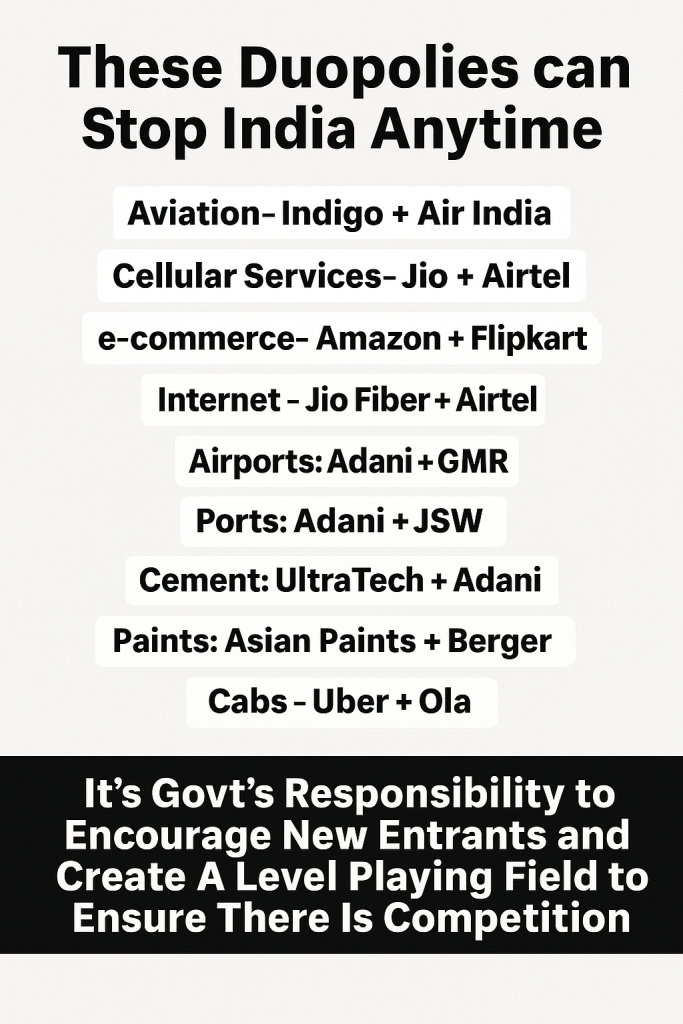
These Duopolies Can Stop India Any Time
Look around your everyday life in India. Flights, mobile networks, food delivery, cabs, broadband, online shopping, even ports and airports. In sector after sector, you are not choosing from a vibrant market. You are choosing between two giant corporations that dominate everything.
This is not harmless. It shapes prices, innovation, national security, and the future of India’s economy.
Below is a deeper, evidence based look at the sectors listed in the poster, along with what global regulators are doing about similar concentration.
1. What Is A Duopoly And Why Does It Matter?
A duopoly is when just two companies control most of a market. Economists broadly place this under oligopoly – few players, high entry barriers, and enormous power to influence prices and behaviour.
Global competition bodies repeatedly warn that when only a couple of firms dominate a critical sector, you inevitably get:
- higher prices
- reduced innovation
- suppressed wages and bargaining power
- increased inequality
- disproportionate political influence
In simple Indian english: when just two companies own the ground, they slowly start owning you.
2. India’s Growing Landscape Of Duopolies
Aviation – IndiGo + Air India
- IndiGo controls around 65 percent of India’s domestic market. Tata’s Air India group has another big chunk of the rest.
- On roughly 60 percent of IndiGo’s routes, it faces no competitor at all. That is monopoly level power.
The recent nationwide flight chaos after IndiGo mishandled pilot rest changes proved a simple truth: when one dominant airline makes mistakes, the whole country pays.
Telecom And Broadband – Jio + Airtel
- In wireless broadband, Jio and Airtel together hold well over three quarters of the market.
- In wired broadband, JioFiber plus Airtel again form the majority share in many circles.
Indians often say they have “choice”, but the numbers show a straightforward duopoly.
E Commerce – Amazon + Flipkart
- Most industry studies describe India’s online retail as an Amazon – Flipkart duopoly controlling the bulk of gross merchandise value.
- New players like Meesho are growing, but the main rails of organised online shopping still run through these two platforms.
- Even the Supreme Court has flagged concerns that such platforms can distort markets and crush small sellers.
Digital Advertising – Google + Meta (With Amazon + Flipkart Rising)
The poster did not mention it, but it is impossible to ignore:
- Google and Meta dominate India’s digital ad economy, just like globally.
- Amazon and Flipkart are becoming massive ad platforms, rivalling top TV broadcasters in ad revenues.
When two or three companies control what Indians see online, that is not a small side issue.
Airports And Ports – Adani + GMR / JSW
- Private airports are dominated by Adani Group and GMR.
- In ports, Adani Ports and JSW handle a big share of private capacity.
These are the country’s gateways for energy, trade and people. Concentration here is a national security question, not just a business topic.
Cement, Paints, Cabs, Food Delivery
- Cement – UltraTech remains the giant, and Adani has rapidly become another top tier player, making the market highly concentrated.
- Paints – Asian Paints and Berger hold very high combined share in decorative paints.
- Cabs – In most Indian cities, app based taxis practically mean Uber or Ola.
- Food delivery – Swiggy and Zomato form a well known duopoly with no serious third competitor at scale.
Across these sectors, the top two companies often control somewhere between 70 and 90 percent of the market. That is not “vibrant competition”.
3. This Is Not Natural Capitalism. It Is Policy Driven Concentration.
A common excuse is “If they are big, they must be efficient.” Reality is more structural and a bit ugly.
Research across Indian sectors shows duopolies grew because of a mix of:
- access to cheap global capital for a few favoured groups
- network effects that lock users into one platform
- loss making discount wars that smaller firms simply could not survive
- policies that unintentionally make entry expensive: spectrum fees, airport charges, complicated compliance etc
Where the state looks away or tilts the field, concentration accelerates. A genuine free market needs many competitors, not two national champions protected by silence.
4. How The World Is Pushing Back Against Dominant Giants
United States vs Google
- A US federal court ruled that Google illegally monopolised key parts of the digital advertising market.
- Another ruling forced Google to rebid default search deals every year, breaking its long time lock on browsers and smartphones.
The message is simple: no company gets to permanently control the world’s information pipes.
European Union vs Big Tech
- The EU has hit Google with several antitrust decisions and fines of more than 8 billion euros across search, Android and ad tech.
- Regulators are also probing Meta for blocking rival AI chatbots on WhatsApp, calling it potential abuse of dominance in communications.
Europe treats competition as a democratic safeguard, not just a slogan in a budget speech.
5. Why Duopolies Are Dangerous For India
Systemic Fragility
The IndiGo meltdown showed how one company’s missteps can choke national aviation for days. Now imagine similar failures in:
- one of only two major telecom networks
- a big private port operator
- the dominant payment or cloud platform
This is no longer just an economic debate. It becomes a national resilience problem.
Hidden Taxation Through Higher Prices
Studies on oligopolies show they often behave like quiet cartels, pushing up prices without explicit collusion.
Indians experience this daily:
- sky high flight fares during crises and holidays
- data prices that creep up once smaller rivals die
- cement and paint price spikes that affect housing costs
- cab surge pricing where you are trapped between two apps
For poor and middle class households, this is basically a hidden tax, with zero debate in Parliament.
Political Capture
When a few firms dominate entire sectors, their ability to influence regulation becomes enormous. This is visible not just in India but also in US and EU debates.
Over time, the political system starts revolving around the comfort of a few conglomerates, not around citizens or small businesses.
6. What The Indian Government Must Do Next
Strengthen Competition Policy
- Give the Competition Commission of India more staff, better data, and faster procedures.
- Introduce ex-ante rules for digital markets to prevent gatekeeping behaviour before it becomes abuse.
Remove Barriers For New Players
- Fix licence fees, spectrum charges, airport and port concession structures that favour only very large players.
- Make credit and land access easier for smaller firms, start ups and regional operators.
Mandate Interoperability And Data Portability
- In telecom, fintech and e commerce, enforce open standards and fair API access.
- Make it easier for consumers and businesses to switch platforms without losing their data and history.
Transparent Procurement And Subsidy Rules
- PLI schemes, concessions, infrastructure contracts and government advertising must follow clear, published rules.
- Stop the feedback loop where the same two or three firms keep winning every contract.
Respect Regulatory Independence
Democracies keep markets fair by respecting watchdogs, not by suffocating them. Regulators, courts and audit bodies are not enemies of growth. They are the seat belts.
7. What Citizens Can Do
- Support smaller alternatives when they exist, even if it is slightly less convenient.
- Call out policies that obviously favour only one or two conglomerates.
- Explain to others that highly concentrated markets are not “efficiency”, they are a structural risk.
India’s economic destiny cannot be shaped by two companies in each sector. A competitive economy with many players is the only way a billion people get real freedom, innovation and fair pricing.
Until we fix this, the warning stands: These duopolies can stop India any time.
