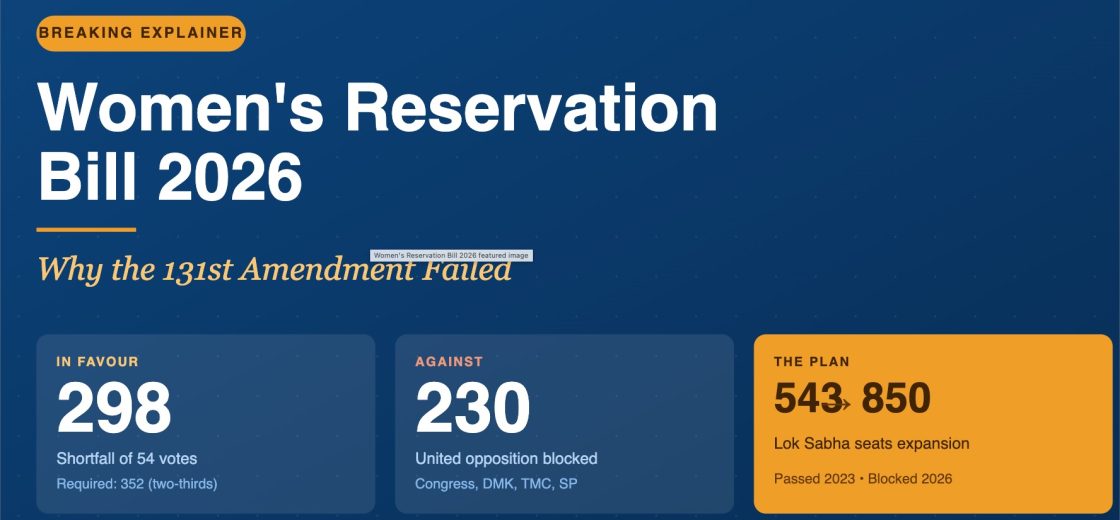
The Women’s Reservation Bill (Nari Shakti Vandan Adhiniyam) was passed with an overwhelming 454 votes in 2023, but it still hasn’t been implemented three years later. On April 17, 2026, the 131st Constitutional Amendment Bill, which was meant to operationalise it, was defeated in the Lok Sabha by 298-230. The government needed 352 votes (two-thirds special majority) but fell short by 54 votes. The bill aimed to increase Lok Sabha seats from 543 to 850. Both the government and opposition have strong arguments. Here’s the complete picture.
Table of Contents
- The Complete History of the Women’s Reservation Bill
- The 2023 106th Amendment: What Actually Passed?
- What Happened in April 2026?
- Inside the 131st Amendment Bill
- The Government’s 10 Key Arguments
- The Opposition’s 10 Key Arguments
- How Will This Affect Kerala and Southern States?
- Frequently Asked Questions
- Final Analysis
The Complete History of the Women’s Reservation Bill
The idea of women’s reservation is not new. The bill has been introduced in Parliament multiple times since 1996, failing each time due to lack of consensus. After a 27-year legislative struggle, it finally became a reality in 2023.
Timeline:
- 1996: The Deve Gowda government introduced the bill for the first time
- 1997-1998: Further attempts failed
- 2008-2010: The Manmohan Singh government passed the 108th Amendment Bill in Rajya Sabha, but couldn’t bring it to Lok Sabha
- September 20, 2023: Passed in Lok Sabha with 454-2 votes
- September 21, 2023: Passed unanimously in Rajya Sabha with 214-0 votes
- September 28, 2023: President Droupadi Murmu signed it; became the 106th Constitutional Amendment Act
- April 17, 2026: 131st Amendment Bill defeated in Lok Sabha (298-230)
The 2023 106th Amendment: What Actually Passed?
Known as the Nari Shakti Vandan Adhiniyam, this law reserves 33% of seats for women in the Lok Sabha and state legislative assemblies. The reservation is valid for 15 years. It also applies proportionally within SC/ST reserved seats.
But there was a catch:
The law included a provision stating that the reservation would not come into effect immediately. Two things had to happen first:
- A new census (population enumeration)
- Delimitation (redrawing of constituencies) based on that census
Because of this condition in Article 334A, the law was technically passed in 2023 but remained practically dormant.
What Happened in April 2026?
On April 16, 2026, the Modi government introduced three bills together in a special parliamentary session:
- Constitution (131st Amendment) Bill, 2026 – The main bill
- Delimitation Bill, 2026 – The constituency redrawing process
- Union Territories Laws (Amendment) Bill, 2026 – Extending reservation to UTs
Voting Results (April 17, 2026):
| Detail | Count |
|---|---|
| Total MPs present | 528 |
| Votes in favour | 298 |
| Votes against | 230 |
| Two-thirds majority required | 352 |
| Shortfall | 54 votes |
With the 131st Amendment defeated, the other two bills automatically couldn’t proceed. This marks the first time in 12 years that a Modi government constitutional amendment has failed in Parliament.
Inside the 131st Amendment Bill
Here’s what the bill aimed to accomplish:
Main provisions:
- Increase Lok Sabha seats from 543 to 850 (815 states + 35 UTs)
- Carry out delimitation based on the 2011 census
- Remove the census condition from women’s reservation
- Give the central government power to appoint the Delimitation Commission
The real political math:
33% of 543 seats = approximately 181 seats required for women. Currently there are only 78 women MPs (14%) in Lok Sabha. This means roughly 103 seats would need to transfer from male MPs to women.
33% of 850 seats = 280+ women seats. By creating 307 new seats, this can be balanced out without existing MPs losing their seats.
The Government’s 10 Key Arguments
Arguments put forward by Home Minister Amit Shah and PM Narendra Modi:
1. “One Person, One Vote, One Value”
This is the foundational principle set by the Constituent Assembly. When 543 seats were fixed based on the 1971 census, India’s population was 54 crore. Today it’s 140 crore. Each MP represents an average of 25 lakh people – the highest ratio in the world. This weakens democratic representation.
2. Implementing in 543 Seats Would Hurt Tamil Nadu
Amit Shah’s argument: “If we implement women’s reservation in 543 seats based on the 2011 census, Tamil Nadu would lose 6 seats. The 50% seat increase protects all states from this loss.”
3. Southern States Will Get More Seats
Amit Shah’s state-wise data:
| State | Current | Proposed | Increase |
|---|---|---|---|
| Tamil Nadu | 39 | 59 | +20 |
| Kerala | 20 | 30 | +10 |
| Andhra Pradesh | 25 | 38 | +13 |
| Telangana | 17 | 26 | +9 |
| Karnataka | 28 | 42 | +14 |
| Total Southern States | 129 | 195 | +66 |
In percentage terms: 23.76% → 23.87% (slight increase).
4. SC/ST Seats Will Increase
Shah: “Only through delimitation can SC/ST reserved seats increase proportionally. Those opposing delimitation are effectively opposing the increase in SC/ST reservation.”
5. Caste Census Will Be Conducted Together
PM Modi has decided to include caste enumeration in the 2026 census. Shah said: “The Congress governments of 1951 and 1971 didn’t conduct caste enumeration in the census. It’s the BJP government that’s now bringing it in.”
6. Historical Failures
Shah: “From 2008 to 2014, Manmohan Singh’s government passed the 108th Amendment Bill only in Rajya Sabha. They failed to bring it to Lok Sabha. The Modi government passed a bill that had been pending for 27 years.”
7. Current Structure Continues Until 2029
“Nothing will change immediately. The 543-seat structure will continue until the 2029 Lok Sabha elections. The ‘immediate loss’ concern is politically motivated.”
8. Women’s Empowerment Value
At the panchayat level, 14 lakh women serve as elected representatives. But in Lok Sabha, only 14% – far below the global average of 26%. Genuine empowerment requires reservation at higher levels.
9. Federal Balance Objective
Articles 81, 82, and 170 make periodic delimitation a constitutional obligation. It was frozen through the 42nd Amendment in 1976, and extended through the 84th Amendment in 2001. Further delay is unacceptable.
10. No Religion-Based Reservation
Shah’s clarification: “The Constitution doesn’t permit reservation based on religion. The propaganda about special reservation for Muslim women is completely false.”
The Opposition’s 10 Key Arguments
Arguments from Rahul Gandhi, Shashi Tharoor, MK Stalin, Priyanka Gandhi, and others:
1. Protecting Sitting MPs’ Seats (The Math Logic)
33% of 543 seats = 181 women seats. Beyond the current 75-78 women MPs, roughly 100+ seats would need to transfer from male MPs to women. By expanding to 850 seats and fitting reservation into 307 new seats, sitting MPs’ interests are protected. This is the real motive, not women’s empowerment.
2. Delink Demand (Shashi Tharoor)
“We are not against women’s reservation. Bring back the 2023 bill and implement it today – we’ll support it. Delimitation is a separate issue that needs detailed discussion. Don’t entangle the two.”
3. Injustice to Southern States (MK Stalin)
“States like Tamil Nadu and Kerala that successfully implemented population control are being punished. States that didn’t control population like UP and Bihar will gain proportional power. This threatens the federal structure.”
4. Using Old 2011 Census Data
Rahul Gandhi: “Why use a 15-year-old 2011 census? The 2026 census is underway – let it complete first. Only proceed after a fresh census that includes OBC data.”
5. No OBC Reservation
Dimple Yadav (SP): “There’s only SC/ST sub-quota within women’s seats. No separate reservation for OBC women. This bill is anti-OBC and anti-Dalit.”
6. Political Map Redrawing (Priyanka Gandhi)
“This isn’t a women’s reservation bill – it’s an attempt to redraw India’s political map. The BJP is nervous about elections, so they want to redraw constituencies for electoral advantage.”
7. Council of Ministers Bloat
Under Article 75’s 15% rule, if seats increase to 850, the Cabinet size will grow from 81 to 122 members. More ministerial posts mean more political patronage and higher costs to the exchequer.
8. Rajya Sabha Power Dilution
The Lok Sabha to Rajya Sabha ratio will change from 2.2:1 to 3.3:1. This reduces Rajya Sabha’s influence in presidential and vice-presidential elections. States’ upper-house representation power gets diluted.
9. Suspicious Timing
Why this rush during the Tamil Nadu and West Bengal assembly elections? DMK and TMC argue this is an electoral strategy designed to hurt opposition-ruled states.
10. Basic Structure Threat
KC Venugopal’s argument: “The Constitution caps Lok Sabha at 550 seats. Jumping to 850 seats challenges the basic structure doctrine of the Constitution itself.”
How Will This Affect Kerala and Southern States?
This bill is especially relevant for Malayalis and other southerners. Both sides’ arguments in a Kerala context:
Government’s claim (with government’s numbers):
- Kerala’s MP seats will grow from 20 to 30 (+10)
- Percentage: 3.68% → 3.67% (almost the same)
- 33% means 10 women MP seats from Kerala
Opposition’s counter:
- Kerala is a national model for population control. UP has 24 crore people, Kerala has just 3.5 crore
- While absolute seats increase, northern states get a massive proportional advantage
- The effective weight of southern voices in Parliament’s decision-making will reduce
- Hindi-belt centric policies can be pushed through more easily
The real question for Kerala: Even with absolute seat increase, how effective will Kerala’s voice be in policy decisions when the total Parliament has 850 members? Is absolute representation or proportional power more important?
Frequently Asked Questions
Has the Women’s Reservation Bill been passed?
Yes. On September 20, 2023, Lok Sabha passed the bill (106th Constitutional Amendment, Nari Shakti Vandan Adhiniyam). Rajya Sabha passed it on September 21, 2023. The President signed it on September 28, 2023. It was officially notified on April 16, 2026.
Then why isn’t it being implemented?
The 2023 law contained a condition – a census and delimitation must happen first. The government tried to remove this condition in April 2026 through the 131st Amendment, but couldn’t secure the two-thirds majority in Lok Sabha.
Why did the 131st Amendment Bill fail?
Constitutional amendments require a special two-thirds majority. Of the 528 MPs present, 352 votes were needed. The government got only 298 – falling short by 54 votes. A united opposition successfully blocked it.
Can’t women’s reservation be implemented in the existing 543 seats?
Technically yes – this is the opposition’s main demand. But the government argues that doing so based on the 2011 census would cost some states seats (especially Tamil Nadu). In reality, over 100 sitting MPs would need to give up their seats for women candidates – politically difficult for all parties.
When will the 131st Amendment be brought back?
No announcement yet. A fresh attempt before the 2026 census completes will be difficult for the government. There’s a possibility of a fresh bill in 2027-2028.
How many seats will Kerala gain?
According to the government’s figures: 20 → 30 (+10 seats). In percentage terms, almost the same (3.67%). Through 33% reservation, about 10 seats would go to women.
Will this affect the 2024 Lok Sabha results?
No. The 2024 election already happened under the 543-seat structure. These changes, even if eventually passed, would apply from the 2029 elections onwards.
Final Analysis
Both sides have legitimate points in the women’s reservation debate:
Government’s logic: Implementing in 543 seats would cause state-level disruption, proper representation needs delimitation, southern states gain absolute seats under the new plan.
Opposition’s logic: A bill passed three years ago still not being implemented shows intent problems, the 850-seat expansion is political map redrawing, southern states’ effective power reduces even with more absolute seats.
The real question: If both sides are sincere, why hasn’t a compromise formula emerged? For example:
- Implement the 2023 bill immediately (in 543 seats)
- Complete fresh census + delimitation by 2027, then consider seat expansion
Why isn’t this happening? Perhaps because both sides have political considerations – the government wants expansion, the opposition wants to block expansion. The real victims are 140 crore Indians and the women still waiting for a 15-year-old reservation promise to become reality.
What’s next? A fresh attempt before the 2026 census completes is unlikely. Implementation before the 2029 Lok Sabha elections seems improbable. The Nari Shakti Vandan Adhiniyam passed in 2023 remains a law on paper, but practically dormant.
Share this: If this article helped you understand the issue, please share it. Every Indian voter deserves to know these facts – spread it on WhatsApp, Facebook, and X (Twitter).
Tell us in comments: Should the government have implemented it in 543 seats as the opposition demanded? Or is the 850-seat expansion the right approach?
Sources: PIB India, The Wire, PRS Legislative Research, The Week, Republic World, Outlook India, Sansad TV records.
