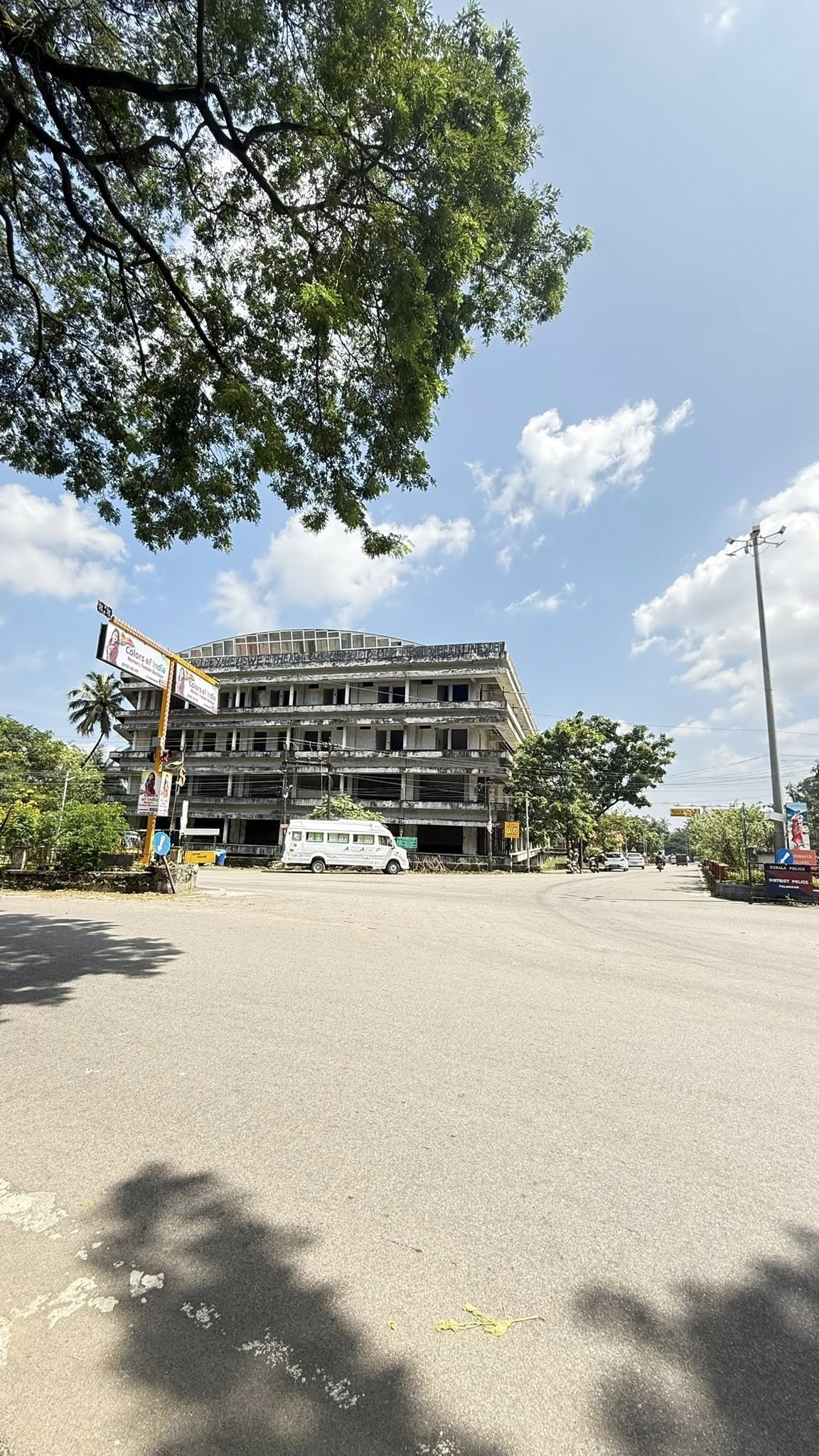
Near the historic Government Victoria College in Palakkad stands a massive concrete shell — a structure that was supposed to become the Palakkad Indoor Stadium, a hub for sports and youth development. Fourteen years later, it remains unfinished. Not under renovation. Not in use. Just unfinished.
This is not a story about one delayed building. It’s a case study of how governance failure and bureaucratic paralysis turn public promises into public ruins.
The Stadium That Never Became
The project was first approved around 2010 with an estimated cost of ₹13.25 crore. The plan looked ambitious — indoor courts for basketball, volleyball, shuttle badminton, handball, tennis; dormitories for athletes; a spectator gallery for over 6,000 people; even a swimming pool and commercial spaces to sustain operations.
Construction started with much fanfare. By 2012, about ₹10 crore had already been spent on the main structure. Then the work simply stopped.
For years, the half-built structure stood exposed to rain and time, collecting moss instead of medals. Successive governments came, offered fresh promises, and left. The result is what we see today — a hollow monument to inefficiency.
The Excuses Keep Changing — The Outcome Doesn’t
When asked why it hasn’t been completed, officials offer the same recycled answers:
- Lack of funds.
- Disputes between agencies.
- Revised project scope.
- Tender delays.
All true — but all preventable. A project like this doesn’t remain incomplete for 14 years because of bad luck. It stays incomplete because no one is held accountable.
Even in 2024, the Sports Kerala Foundation floated a fresh tender titled “Completion of Construction of Palakkad Indoor Stadium – Retender”, again quoting around ₹12.33 crore. Think about that — the government is essentially rebuilding the same project it failed to finish years ago, now at double the cost.
The total projected expenditure now touches nearly ₹25 crore — money that could have built two smaller functional stadiums elsewhere.
A Perfect Mirror of How Kerala Handles Public Projects
This stadium isn’t an exception. It’s the pattern.
We announce grand projects, lay foundation stones with media coverage, then forget them. The cycle repeats across districts — half-finished bridges, stalled hospitals, incomplete stadiums, abandoned flyovers. The political class changes, but the bureaucratic lethargy remains a constant.
Accountability is virtually zero. Ask who’s responsible, and the answer evaporates into a maze of “departments,” “contractors,” and “revised estimates.”
This is not just inefficiency — it’s institutionalised neglect.
What Should Have Been Done (and Still Can Be)
If a government truly wants to fix this, the steps are simple and well-known:
- Conduct a full audit.
Within 30 days, publish a report showing funds spent, progress made, and remaining costs. No secrecy, no excuses. - Appoint a single executing agency.
Decide who owns the project — the Sports Kerala Foundation or the District Sports Council — and empower them to finish it. - Re-scope the project.
Stop waiting for the “perfect” stadium. Complete the core playing areas, utilities, and spectator seating first. Open it for use while finishing other parts in phases. - Lock the funding.
Release funds in tranches tied to progress milestones and publicly report them. - Make it part of a sports ecosystem.
Link the stadium with local schools, sports clubs, and the Kerala Sports Academy so it’s used daily, not ceremonially. - Publish everything online.
Every rupee, every delay, every tender — made visible to citizens.
These are not lofty reforms — they’re basic governance hygiene. The tragedy is that they’re treated as radical ideas in a state that prides itself on “high human development.”
A Minister’s Hypothetical Plan That Makes Sense
When someone asked how I would solve this if I were Kerala’s Sports Minister, the answer is straightforward:
Start with an audit, not a ribbon.
Finish what matters, not what looks good in a photo.
Appoint one agency and hold them accountable with a public deadline.
No new foundation stones, no hollow inaugurations, no speeches — just completion.
And above all, ensure that no sports project in Kerala ever dies half-built again.
A Wake-up Call for Citizens
Palakkad doesn’t lack talent. It lacks functioning infrastructure. The district’s athletes still train in borrowed or outdated spaces while a ₹25 crore stadium sits idle behind locked gates.
Every unfinished project is not just a financial loss — it’s a moral one. It tells citizens that their taxes fund negligence. It tells young athletes that their dreams aren’t worth a follow-up file in the Secretariat.
Kerala often speaks of its “model of governance.” The Palakkad Indoor Stadium is what that model looks like when no one’s watching.
The Bottom Line
A government that cannot complete a stadium in 14 years cannot claim efficiency in anything. This is not about sports — it’s about seriousness.
The Palakkad Indoor Stadium stands as a warning: when governance loses urgency, progress loses meaning.
The people of Palakkad deserve more than scaffolds and slogans. They deserve a government that finishes what it starts.
📹 Footage of the structure shot by PalakkadNews Team, November 2025.
Source references: Manorama Online, Madhyamam, TendersOnTime, Sports Kerala Foundation.
